Saturday, December 18, 2010

Semester Wrap-Up

1) “Most Beautiful Work Award” - Which piece of writing (formal or informal) are you most proud of and why? What other skill or habit have you developed (maybe as a reader?) that you are proud of?

I take the most pride in the Snapshot Narrative. The assignment really pushed me to paint a picture with my writing, which is a fairly unique approach. I put a lot of effort into, changed everything several times, and eventually came out with a good piece of writing.


2) “Lesson Learned” - What content do you feel you have mastered? Or, which skill(s) did you enjoy learning and feel that you have had some success in developing? How so?

Even though I only had one presentation in this class, I feel like my presentation skills improved. Presenting in front of a large group has been troubling for me in past years, but I felt confident and prepared for my inquiry presentation.


3) “Lessons I’d Like to Learn” - Which skills would you like to develop before graduation? What content do you feel that you need to know in order to feel ready for college? Do you have any project ideas?

Maybe study literary devices more. Also, we should have some essay workshops to help prepare us for college essays. I don't have any specific project ideas yet, but anything that improves my writing and reading skills will be good.

Friday, December 3, 2010

Inquiry Project

The inquiry project has confirmed one belief I hold. Nothing in this world is standard. The three books I chose to read for this project, Catch-22, Time's Arrow, and Slaughterhouse V, all deal with the concept of non-linear narrative. This means time is reversed, flipped around, or rearranged. The thesis of my essays on these books has been that time should be accepted the way it is, and not twisted. However, I'm starting to think Slaughterhouse V is an exception. The story follows Billy Pilgrim, a decorated war veteran, alien hostage, and successful businessman. He has become "unstuck in time," meaning he can rearrange it however he pleases. This is the manner in which the story is told. It seems that it's not a bad thing in this plot. He has control. It's not like I've anticipated in other books. In those and in real life, time is either forwards, backwards, or random. Slaughterhouse V is proving that it may be confusing, but treating time as a manipulable fourth dimension isn't so bad. I haven't reached the end, but this seems like a good conclusion thus far. I wonder how I'm going to present what I've learned.

Friday, November 19, 2010

Essay #2 Excerpt

This book also describes the process of going to the bathroom, which you can imagine is incredibly painstaking. In the second chapter, Tod’s passenger examines the way people live this horrid life. “Never watching where they are going, the people move through something prearranged, armed with lies.” Life in reverse yields very little control. Nobody knows where they’re going or what will happen next. One of the few things the passenger does know is that Tod will have another day’s work as a doctor. “Two go in. But only one comes out. Oh, the poor mothers, you can see how they feel during the long goodbye to babies.” Giving birth is never taken lightly, but would ultimately yield more pain if the baby went in instead of out. Doctors being highly trustworthy in our lives is completely flipped in a backwards world. They pay you to hurt you, which is not a world we would want to live in.

Friday, November 12, 2010

The Opposite of Tragedy

The title of this post is the basic summary of the book I'm reading: Time's Arrow. The general story follows a passenger living inside Tod Friendly. Tod is living his life in reverse, and the passenger can't really make sense of it. In some aspect, everything around him is a tragedy. Poop goes back into people, doctors pay people to hurt them, and Tod steals candy from babies for some quick cash. However, as this is the 2nd time I've read this book, I know how it ends. It leads up to one event in history where reversing things is actually good: World War II. The transition of living a new life as unsatisfied doctor under a fake name to helping people who had nothing (plus getting a hot, young wife) makes this the opposite of tragedy.

Sunday, October 31, 2010

The Tragic Song Part 2

This week, I have been continuing on the same concept: learning about tragedy and how to apply it to a song. While the reading articles built on the same ideas about tragedy, actually listening to some tragic music gave me a better idea. I listened to Bach's Air on a G-String, which is widely considered to be a tragic piece. It has lots of tension that is the soundtrack to a character in distress and a couple moments of lighter fare. These help to show the contrast between good and bad that is ever present in tragedy. The tension then comes back, and then keeps building up until the final note, or resolution. This is the one note you keep waiting for to finish the song. It mimics the catharsis of watching or reading a tragedy.

Friday, October 22, 2010

To Write A Tragic Song

This is my challenge. After reading Oedipus, we will be starting on a project in which we make our own tragedy. The tragedy is a story where good fortune turns sour, and is often a cathartic experience instead just a depressing one. I know tons of sad songs, but it will be very tough to embody the tragic spirit right. In Oedipus, he starts out a king, but ends up having sex with this mother and killing his father. He then gouges out his eyeballs, and it all happens because he tried to change his fate. That's the grand realization of the story. Now it's time make a song that exemplifies an idea like that.

Friday, October 15, 2010

We All Think We're The Tragic Hero

This week, we've been learning about tragedy. Specifically, we've started on "the tragedy": Oedipus Rex. A tragic hero is someone whose life is going fine, then turns tragic. Usually, this is a death, a loss of fortune, or a lost connection with a person. We also talked about and watched parts of modern day tragedies, such as The Mission, The Boy in the Striped Pajamas, and the Wrestler. Sometimes we get so wrapped up in the emotions of the characters because they seem so real. They could be us. The protagonist of the last book I read, named Yossarian, thought he was a tragic hero. He complained about having to put his life on the line and having a failed lifeline. But he really doesn't count as a tragic hero because the story started with him in a bad scenario. His life is seldom good. These are my observations.

Friday, October 8, 2010

When Life Has Ceased


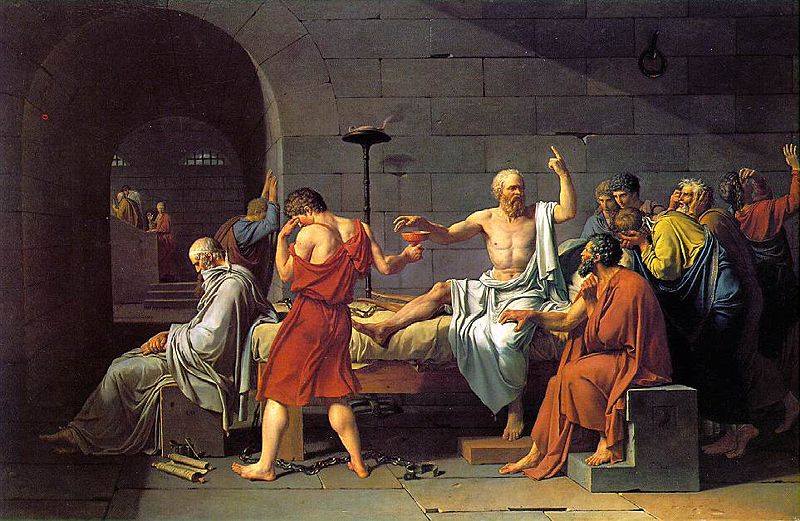
One thing that's been on my mind a lot this week is death. It's not related to what's going on in my life, but it is a big part of my English work. Socrates had a pretty famous death. He died by drinking hemlock, and had no problem with it. He had lived a long life, and had always supported what the government did. He had the chance to escape, but did not want to contradict the principles he held so dearly. He is remembered by the masses for this admirable stance. There is a big contrast between this and the book I've been reading: Catch-22.In this book, Yossarian, the protagonist, is frightened by death, and does everything he can to get away from the place where he faces it. He is an American bomber pilot fighting in Italy as part of World War II. He is required to fly an high amount of missions that keeps on rising. His colleagues are happy-go-lucky, careless, and keep dying off. Whereas Socrates was killed, Yossarian is kept alive by following his principle. He is pessimistic, manic depressive, and labeled crazy, but succeeds in his goal of staying alive. It's a big statement about war. Those who stand by them die by them.